

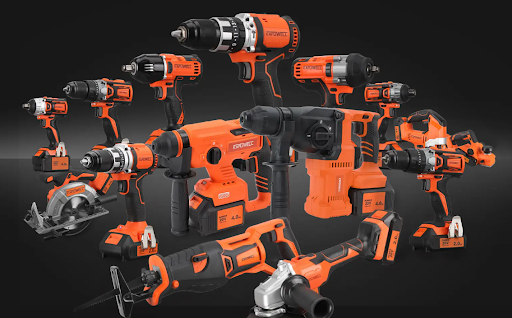
Cordless power tools are no longer a niche category or a premium add-on. Across construction sites, workshops, and distribution channels, cordless tools are becoming the default choice. For wholesale buyers, this shift is not just about technology—it is reshaping product selection, inventory planning, and long-term supply strategies.
Understanding what the cordless revolution really means at wholesale level is essential for businesses that want to stay competitive rather than react late.
Cordless Is Changing How Tools Are Used, Not Just How They Are Powered
The rise of cordless tools is driven less by novelty and more by changes in work patterns. Job sites are becoming more mobile, projects more fragmented, and crews less tolerant of downtime.
Cordless tools remove constraints related to power access and setup time. For wholesale buyers supplying construction, maintenance, or trade markets, this directly affects demand patterns. Tools that enable faster deployment and easier movement are favored, even if their upfront cost is higher.
At wholesale scale, usage convenience increasingly outweighs marginal price differences.
Battery Platforms Are Replacing Individual Tools as the Core Decision
In corded tool sourcing, buyers often evaluate tools one by one. Cordless sourcing works differently. The real decision is the battery platform.
Wholesale buyers now evaluate:
- How many tools share the same battery system
- Whether batteries remain compatible over time
- How charging speed and battery life affect jobsite efficiency
A fragmented battery ecosystem increases inventory complexity and frustrates end users. As a result, wholesale demand is concentrating around stable, scalable battery platforms rather than isolated cordless models.
Inventory Strategy Is Shifting from Tools to Systems
The cordless revolution changes inventory logic. Instead of stocking many standalone tools, wholesale buyers increasingly plan around systems that include tools, batteries, and chargers.
This shift affects:
- SKU structure and assortment planning
- Reorder patterns
- Capital allocation between tools and power units
Buyers who continue to treat cordless tools like corded products often struggle with slow-moving batteries or mismatched accessories. Successful wholesale programs align inventory with system-level demand.
Performance Expectations Are Becoming More Nuanced
Early cordless tools competed mainly on convenience. Today, performance expectations are much higher.
Wholesale buyers now expect cordless tools to handle a wide range of applications previously dominated by corded tools. However, this does not mean every cordless tool must match industrial corded performance.
Buyers evaluate cordless tools based on application fit rather than raw specifications. Tools that deliver reliable, repeatable performance for common tasks are often preferred over high-output models with higher cost and battery consumption.
Pricing Evaluation Has Become More Complex
Cordless tools introduce new pricing dynamics at wholesale level. Buyers no longer evaluate price per tool alone. They consider the total system cost.
This includes:
- Tool price
- Battery and charger investment
- Replacement cycle of power units
Wholesale buyers favor suppliers who offer transparent pricing structures and predictable system costs. Aggressive pricing on tools paired with expensive batteries often creates resistance in the market.
After-Sales and Battery Lifecycle Matter More Than Ever
In cordless wholesale supply, after-sales issues increasingly center on batteries rather than tools.
Buyers evaluate:
- Battery lifecycle consistency
- Availability of replacements
- Clarity around warranty and degradation expectations
Suppliers that cannot support battery continuity create long-term risk, even if initial tool quality is acceptable. Battery support is becoming a defining factor in wholesale supplier evaluation.
Corded Tools Are Not Disappearing—but Their Role Is Narrowing
The cordless revolution does not eliminate corded tools entirely. Certain applications still favor corded power due to sustained output or cost efficiency.
However, at wholesale level, corded tools are becoming more application-specific. They are selected deliberately rather than by default. This changes assortment balance and reduces the number of corded SKUs needed for broad coverage.
Wholesale buyers are shifting toward cordless-first strategies, with corded tools filling targeted gaps.
Supply Stability and Platform Longevity Are Strategic Concerns
As cordless systems evolve, wholesale buyers become cautious about platform longevity. Frequent battery standard changes or rapid platform replacement create stranded inventory.
Buyers therefore evaluate whether suppliers commit to long-term platform support. Stability in battery interfaces and charger compatibility is now a competitive advantage.
Cordless innovation that ignores backward compatibility often struggles at wholesale scale.
The Cordless Future Is About Systems, Not Speed
The future of wholesale power tools is not defined by faster motors or higher voltage alone. It is defined by systems that balance performance, compatibility, cost control, and supply stability.
Wholesale buyers who adapt their sourcing strategies to this reality—by focusing on platforms, inventory structure, and lifecycle support—are better positioned to benefit from the cordless revolution.
For those who continue to treat cordless tools as just another product category, the transition is likely to be disruptive rather than profitable.
