

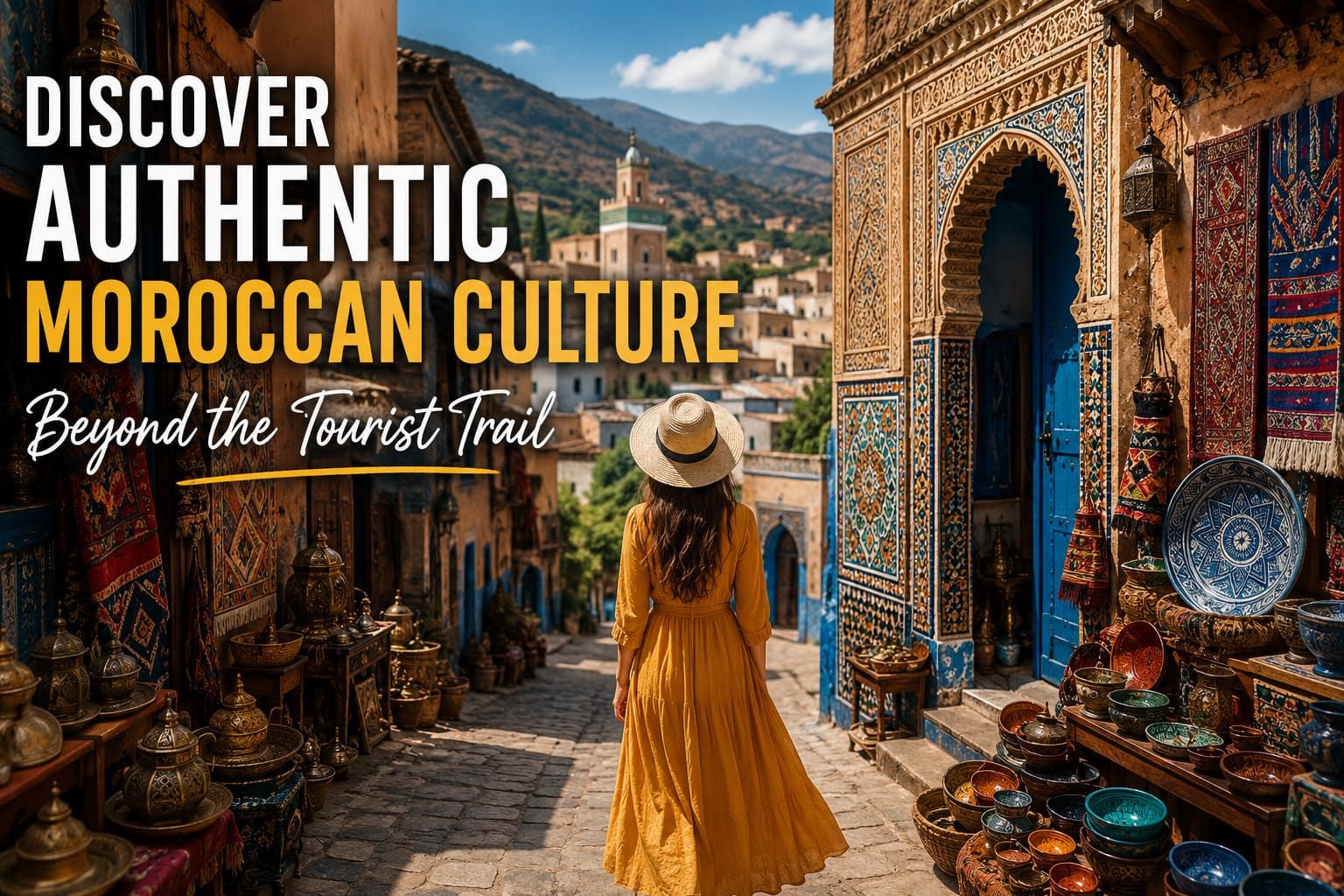
Every neighbourhood in a Moroccan medina has a ferran — a communal wood-fired oven where families bring their own dough to be baked. Stand outside one in Fes at half past seven in the morning and you’ll watch children arrive with trays balanced on their heads, each loaf carrying a pressed mark so the baker knows whose is whose. A thumbprint. A fork pattern. A twist of the wrist that’s been the family signature for three generations.
Nobody built the ferran for visitors. Nobody explains it. It costs about two dirhams and it has been running that way for a thousand years.
That’s the thing about looking for authentic Moroccan culture: it isn’t hiding. It’s operating in plain sight, at times of day when most travellers are still at breakfast, in places that don’t appear on any itinerary because they were never designed to be seen. This guide is about how to find it — and, more usefully, how to understand what you’re looking at once you do.
Why Morocco’s True Magic Exists Beyond Famous Attractions
The famous sites deserve their reputations. The Bahia Palace, the Saadian Tombs, the Chouara tanneries and Jemaa el-Fnaa are extraordinary, and skipping them to prove a point would be silly.
But they’re outputs, not the culture itself. A palace is what a culture produced four centuries ago. The culture is what happens at seven in the morning and seven in the evening, either side of the visiting day, when the same medina does what it has always done — trading, baking, arguing, praying, delivering things by donkey.
The travel designers at Culture Insider have a shorthand for this: monuments in the middle of the day, life at the edges of it. Reorganising an itinerary around that single idea changes almost everything about how a first trip to Morocco feels.
What Makes Moroccan Culture So Unique?
Morocco sits where three worlds meet, and it has kept something from each of them.
The Amazigh — Berber — peoples were here first, thousands of years before anyone else arrived. Arab-Islamic dynasties came in the seventh and eighth centuries. Andalusi refugees fleeing Spain after 1492 brought the music, cooking and architecture that still define Fes and Tetouan. Trans-Saharan caravans carried gold, salt and enslaved people north, and with them the spiritual traditions that became Gnawa. Jewish communities lived here for roughly two thousand years. France and Spain left a residue only a century old.
None of this was replaced. It was layered. That’s why a Moroccan wedding can involve an Andalusi orchestra, an Amazigh dance and a Gnawa troupe on the same night — and why the 2011 constitution recognises Tamazight alongside Arabic as an official language.
The Importance of Local Traditions
Here’s what most travel writing about Moroccan traditions misses: they’re mostly engineering, not folklore.
Take the agdal, still alive across the High Atlas. Villages collectively close a mountain pasture for part of the year and reopen it by common agreement — a grazing rotation that stops the land being stripped. Nobody polices it from outside. The decision sits with the jemaa, the village assembly, which also allocates irrigation water and settles disputes.
Or the khettara, the underground channels that carried groundwater by gravity for kilometres into the oases of the Tafilalet and the Marrakech plain. Some are pre-Islamic. In the palm groves, water rights are still measured in units of time rather than volume — your family’s share is a certain number of minutes of flow, at a certain hour.
Understanding that these systems exist for reasons changes how you read a landscape. That terraced hillside isn’t picturesque. It’s a solution.
Meet the Amazigh (Berber) Communities
“Berber” comes from the Latin for barbarian, which is why many people prefer Amazigh — plural Imazighen, roughly “free people.” It isn’t one group. Three main language varieties are spoken: Tarifit in the Rif, Tamazight across the Middle Atlas, and Tashelhit in the High Atlas and the Souss. They’re distinct enough that speakers often switch to Arabic to understand each other.
Tifinagh, the Amazigh script, descends from ancient Libyco-Berber writing and now appears on road signs and government buildings across the country — one of the more visible cultural shifts of the last two decades. Yennayer, the Amazigh new year in mid-January, became an official national holiday in 2024.
If you’re invited into a home in the Atlas, expect tea, bread, argan oil or olive oil, and an insistence that you eat more than you want to. Refusing outright is the one genuine misstep. Accept a little, praise it, and accept again.
Collective dance you may encounter
- Ahidous. Middle Atlas. Lines of men and women shoulder to shoulder, answering each other in sung verse, sometimes for hours.
- Ahwash. Souss and western High Atlas. Circular, drum-driven, often accompanied by the bendir frame drum.
- Taskiwin. A martial dance of the western High Atlas performed with a decorated horn. UNESCO placed it on the Urgent Safeguarding list in 2017 because the number of villages still performing it has fallen sharply.
Life Inside Morocco’s Ancient Medinas
A medina looks chaotic until somebody shows you the pattern. Traditionally, every residential quarter was built around five things: a mosque, a hammam, a ferran, a public fountain and a Quranic school. If you can find those five, you’ve found the centre of a neighbourhood — and they’re usually within ninety seconds of each other.
The lanes branch from public to private as you go. A wide commercial street feeds into narrower ones, which feed into the derb — a dead-end lane that historically housed an extended family. Turning into one uninvited is closer to walking into somebody’s hallway than onto a street. Fes el Bali has around nine thousand of these lanes and remains one of the largest car-free urban areas in the world.
The hours matter more than the map. Souks by trade rather than by geography — coppersmiths together, dyers together, carpenters together — get loud around ten and quiet at prayer times. The best hour to walk a medina is the first one after it opens.
Traditional Moroccan Hospitality
Moroccan hospitality has rules, and knowing three of them will make you a far better guest.
First, the communal dish. When a tagine or couscous arrives, you eat from the wedge directly in front of you, not from the middle and never from across the plate. The host will push the best pieces of meat and vegetable toward guests as the meal goes on — that’s their job, and letting them do it is part of yours.
Second, bread is not food in the ordinary sense. It’s the utensil, and it carries a kind of sanctity: you’ll notice Moroccans never bin stale bread. It goes on a wall or a ledge for animals or for someone who needs it.
Third, an offer is made three times before it’s meant to be accepted, and refusing once isn’t rude — it’s expected. Refusing three times is a message. Tea works the same way: poured from height to aerate it, always by the host, always more than you asked for.
Moroccan Cuisine Beyond Tagine
Couscous was inscribed by UNESCO in 2020 as shared heritage across the Maghreb, and it’s still overwhelmingly a Friday dish — served after midday prayers, often to a house full of relatives. Turn up expecting it on a Tuesday and you’ll be disappointed.
Dishes worth seeking out, none of which appear on many hotel menus:
- Rfissa. Shredded msemmen pancake over chicken in a fenugreek and ras el hanout broth. Traditionally cooked for women after childbirth — the fenugreek is believed to aid recovery. Fassi households take it seriously.
- Madfouna. The stuffed flatbread of the Tafilalet, filled with spiced meat and onion, baked in ash. Sometimes sold to visitors as “Berber pizza,” which undersells it.
- Bissara. A thick fava bean soup with olive oil and cumin, eaten for breakfast in winter and costing almost nothing.
- Khlii. Preserved spiced beef, sun-dried and stored in fat — the pre-refrigeration technology of the south, still eaten with eggs.
- Amlou. Roasted almonds ground with argan oil and honey, from the Souss. The good stuff is gritty, not smooth.
Regional character is real. Fassi cooking is sweeter and more perfumed, an Andalusi inheritance. The Souss cooks with argan. The Atlantic coast is about fish landed that morning. In the deep south, Hassani culture brings camel meat and a heavier, three-round tea ritual.
Local Markets and Artisan Workshops
Moroccan crafts are still organised by guild. A workshop is run by a maalem — a master — who trained for years under another maalem, and who now trains apprentices in the same room. In Fes the guilds have functioned more or less continuously since the medieval period, and the amin, the elected head of a trade, still arbitrates disputes within it.
This is why buying at the source is different in Morocco from most places. You’re not visiting a demonstration. You’re standing in a business that has a hierarchy, a waiting list and a reputation to protect.
Two practical suggestions. Visit an Ensemble Artisanal — the state-run craft centres in Marrakech, Fes and Rabat — early in your trip, because prices there are fixed and slightly high, which gives you a reliable baseline before you negotiate anywhere else. And go to a weekly rural souk if your route allows it. Dozens of Moroccan towns are named after their market day — Khemis is Thursday, Tnine is Monday, Sebt is Saturday — and on the right morning those places are the real economy at work.
| Common mistake: Treating a workshop visit as a shopping obligation. If a guide’s income depends on where you spend, the itinerary isn’t really yours. Ask for a no-commission commitment in writing before you book, and you’ll see workshops chosen for craft rather than kickback. |
Traditional Music and Festivals
Morocco’s music is where its layers are easiest to hear.
Al-Ala, the Andalusi classical tradition, is built on the nuba — long suites in fixed modes, brought north from Spain and preserved in Fes and Tetouan. Malhun is sung poetry from the Tafilalet, historically the art of the urban craft guilds; its verses are in dialectal Arabic and, in the oldest repertoire, Hebrew. Gnawa is something else: descended from the traditions of enslaved West Africans, built around the three-stringed guembri and iron qraqeb, and performed at all-night lila ceremonies that are healing rituals before they are concerts.
The moussem is the older, deeper version of a festival — an annual pilgrimage gathering, usually tied to a saint’s shrine, combining religious observance with markets, music and horsemanship. Tbourida, the charging cavalry display in which riders fire muskets in unison, belongs to this world rather than to the tourist calendar.
| UNESCO-inscribed element | Year | Where you might encounter it |
|---|---|---|
| Jemaa el-Fnaa cultural space | 2008 | Marrakech, after dusk — storytellers, musicians, herbalists |
| Moussem of Tan-Tan | 2008 | Southern Morocco, a gathering of Saharan nomadic tribes |
| Cherry Festival of Sefrou | 2012 | Sefrou, near Fes, each June |
| Argan tree practices | 2014 | Souss region women’s cooperatives |
| Taskiwin dance | 2017 | Western High Atlas villages — on the Urgent Safeguarding list |
| Gnawa | 2019 | Essaouira and Marrakech; the Essaouira festival each June |
| Couscous | 2020 | Friday tables nationwide |
| Tbourida | 2021 | Moussems and regional festivals, spring to autumn |
| Malhun | 2023 | Fes and Meknès, in guild and concert settings |
| Henna rituals | 2024 | Weddings, festivals and family celebrations |
Morocco holds sixteen inscriptions on UNESCO’s intangible cultural heritage lists, including several shared with neighbouring countries. A selection is shown here.
Luxury Travel Can Also Be Authentic
The idea that comfort and authenticity pull against each other is one of the more persistent myths in travel writing, and it doesn’t survive contact with Morocco.
What money actually buys here is time and access — which happen to be exactly what cultural depth requires. A private vehicle means you can leave at six to reach a mountain souk before the traders pack up. A restored riad is itself a piece of living heritage, employing the plasterers, tile-cutters and cedar carvers who keep those trades commercially viable. The Royal Mansour’s construction famously drew on hundreds of Moroccan craftsmen; that’s patronage, not decoration.
The distinction worth drawing isn’t luxury versus authenticity. It’s whether a trip is designed around access or around amenities. Culture Insider builds its bespoke Morocco tours on the first premise — the assumption being that a guest who has paid for a private guide would rather use them to get into a working atelier than to skip a queue.
How Private Local Guides Transform Your Experience
Morocco licenses its guides through the Ministry of Tourism, and the card matters. The people who attach themselves to visitors at medina gates are unlicensed, and their revenue model is commission.
A good licensed guide does something harder than narration. They translate context. Why a door has two knockers at different heights, and what that told a household about who was calling. Why the tanneries smell the way they do and what the pigeon droppings are actually for. Why nobody in the room will start eating until the eldest person does.
Ask for a specialism when you book. Guides who focus on architecture, textiles, food or Jewish heritage exist in every major city, and matching one to your interests is the single highest-return decision in planning Morocco cultural tours. The team at Culture Insider names its guides before a deposit is taken, which is a reasonable standard to hold any operator to.
How Families Can Experience Authentic Morocco
Children are an extraordinary social passport in Morocco. Doors open, conversations start, and a family with a seven-year-old will be invited into more homes in a week than a couple will in a month.
The experiences that work are the ones with a task attached. Kneading bread and carrying it to the ferran. Throwing a pot in Fes or Safi. Helping crack argan nuts at a women’s cooperative in the Souss. Learning three phrases and using them badly to enormous approval.
One caution worth stating plainly: avoid school and orphanage visits, however well-intentioned the offer. They disrupt classrooms and raise real safeguarding concerns, and reputable operators arranging private family tours in Morocco will steer you toward workshops, cooperatives and family homes instead — settings where the exchange is genuinely mutual.
Hidden Villages Worth Visiting
Chefchaouen and Aït Ben Haddou are wonderful and no longer remotely undiscovered. These are the places we send travellers who have a spare day and want to use it well.
| Village | Where | Why go |
|---|---|---|
| Aït Bougmez | Central High Atlas | A wide green valley with almost no through traffic; walking, mud-brick architecture, village guesthouses |
| Bhalil | Near Sefrou | Troglodyte houses built into the hillside, still lived in; button-making is the local trade |
| Moulay Idriss Zerhoun | Near Meknès | Morocco’s holiest town, wrapped around a founder’s shrine, twenty minutes from Roman Volubilis |
| Tamnougalt | Draa Valley | A crumbling kasbah village among palms, on the old caravan route to Timbuktu |
| Taliouine | Anti-Atlas | Morocco’s saffron capital; the October harvest is done entirely by hand at dawn |
| Ameln Valley | Near Tafraoute | Pink granite, painted rocks, almond blossom in February, Tashelhit-speaking villages |
Responsible Cultural Tourism
Taskiwin is on UNESCO’s urgent list because the villages still performing it can be counted. That’s what cultural loss looks like in practice, and tourism can push either way.
- Buy at source. A rug bought from the weaver rather than a middleman changes a household’s income. Ask who made it and where — a good shop will tell you.
- Check the cooperative. Argan cooperatives vary enormously. A genuine women’s cooperative will explain its membership and pay structure; a roadside shop with a woman grinding decoratively by the door is a different proposition.
- Ask before photographing. Especially of women, children and in rural areas. A refusal isn’t rudeness, and a camera pointed without consent is the fastest way to sour a village.
- Think about water. Oases and southern valleys are under real strain. A swimming pool in the Draa is not a neutral amenity, and choosing properties that manage water seriously matters more here than in most destinations.
- Tip properly. Guides, drivers and household staff. Roughly 200–400 dirhams a day for a guide, 150–250 for a driver, is normal and appreciated.
Tips for Respecting Moroccan Customs
- Greet before you ask. “Salam alaikum” opens doors a direct question won’t.
- Right hand for eating, greeting and passing money.
- Shoulders and knees covered in medinas and religious sites. There’s no requirement for women to cover their hair.
- Shoes off when entering a home; follow your host.
- Mosques are generally closed to non-Muslim visitors, with the Hassan II Mosque in Casablanca a notable exception.
- During Ramadan, eat and drink discreetly in public out of courtesy. Evenings are the best time to be out.
- Accept the tea. Drinking it doesn’t oblige you to buy anything; declining it entirely is the ruder move.
Frequently Asked Questions
What’s the difference between Amazigh and Arab Moroccan culture?
They’re layered rather than separate, and most Moroccans carry both. Amazigh culture predates the Arab arrival by millennia and is strongest in the Rif, the Atlas and the Souss, with its own languages, script, calendar and institutions like the village jemaa. Arab-Islamic culture shaped the imperial cities and the written tradition. In practice you’ll hear both languages in one conversation and see both influences at the same wedding.
Is it possible to experience real Moroccan culture on a short trip?
Yes, but only if you resist covering ground. Four days in Fes and the surrounding countryside will give you far more cultural depth than ten days spent driving between eight cities. Pick one region, spend mornings and evenings out, and use a licensed guide for the first day so you understand what you’re seeing for the rest of them.
When is the best time to see traditional festivals?
Spring and early summer are richest. The Fes Festival of World Sacred Music and the Gnaoua World Music Festival in Essaouira both fall around late May and June, and the Cherry Festival in Sefrou is a June fixture. Moussems tied to saints’ shrines run mostly from late spring through autumn and shift with the agricultural and lunar calendars, so dates need checking locally rather than assuming.
Why do so many Moroccan town names start with Souk?
Because they’re named after their weekly market day. Souk El Had is Sunday, Souk Tnine Monday, Souk Tleta Tuesday, Larbaa Wednesday, Khemis Thursday and Souk Sebt Saturday. It’s one of the most useful things a visitor can know: arrive on the right morning and you’ll find a functioning rural trading post, arrive on any other day and you’ll find an empty lot.
Are Morocco’s medinas safe to explore independently?
Generally yes, though getting lost is close to guaranteed in Fes. The realistic issues are unlicensed guides at the gates and low-level pressure to shop, not danger. Walk the main arteries, note that lanes narrow as they become more residential, and treat a derb — a dead-end lane — as private space. A guided first walk makes independent exploring afterwards far more enjoyable.
What should I actually buy, and how do I know it’s real?
Buy where it’s made. For rugs, turn the piece over — the reverse shows knot density and whether the dye is vegetable or chemical. For zellige, ask whether the tiles were hand-cut with a menqach or machine-pressed; the hand-cut edges are visibly irregular. For argan oil, culinary and cosmetic are different products and shouldn’t smell the same. Reputable workshops ship internationally, and you should agree the shipping cost before agreeing the price.
Can I attend a Gnawa lila ceremony as a visitor?
Sometimes, and it should be arranged with care. A lila is an all-night healing ritual, not a performance, and attendance depends on the maalem and the hosting family. Some troupes welcome respectful guests for part of the evening. Ask well in advance and accept that the answer may be no — the Essaouira festival is the accessible alternative.
How much Moroccan Arabic do I need?
Four words will carry you a long way: salam (hello), shukran (thank you), bslama (goodbye) and la shukran (no thank you). French is near-universal in business and signage, and English is widely spoken in the hospitality sector. Nobody expects fluency in Darija or Tamazight. The effort itself is what registers, and it visibly changes how you’re treated in souks and villages.
Conclusion
Authentic Moroccan culture tour isn’t a secret list of places. It’s a matter of timing, context and permission — being out at the hours when a city is working, understanding why a tradition exists before you photograph it, and being introduced rather than merely arriving.
Three takeaways worth carrying. Choose fewer regions and stay longer, because depth is a function of nights rather than kilometres. Use a licensed guide early, so the rest of your trip makes sense. And spend your money where it reaches the people who make things.
If that’s the kind of trip you want, it’s worth planning it with people who live inside the culture rather than visit it. The Morocco travel experts at Culture Insider design private journeys from Fes — which mostly means knowing which maalem will open his workshop early, which valley holds its souk on a Thursday, and when to leave a morning completely unplanned. Start the conversation well ahead of spring or autumn, and describe how you want your days to feel rather than which sights you think you should tick off.
About Culture Insider
Culture Insider is a Morocco travel specialist based in Fes, designing private, tailor-made journeys across the country since 2020. The team plans luxury, family and cultural itineraries built around licensed local guides, working artisan workshops and regions most itineraries skip — from the High Atlas valleys to the Saharan south. Having arranged more than 320 privately guided trips, they focus on access and pacing rather than checklists, and on travel that supports the craftspeople and communities it visits.
