

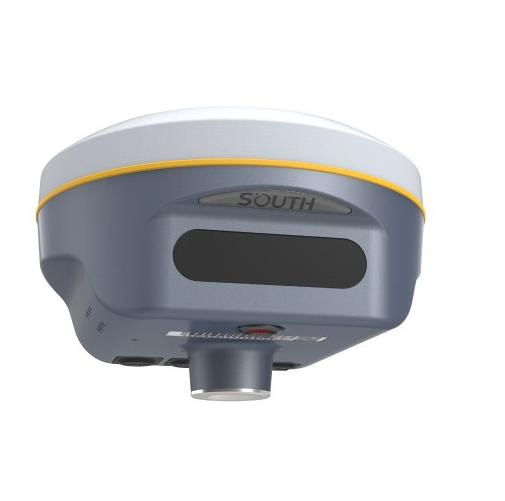
In modern surveying and positioning technology, accuracy and reliability depend heavily on the equipment used in the field. One of the most important technologies today is the use of Global Navigation Satellite System combined with Real-Time Kinematic (RTK) corrections. These systems enable centimeter-level accuracy, making them essential in construction, agriculture, and land surveying.
This article explores Comparing Portable and Fixed GNSS rtk receiver Systems, their differences, advantages, and ideal use cases to help professionals choose the right solution.
Understanding GNSS RTK Receiver Systems
Before Comparing Portable and Fixed GNSS RTK Receiver Systems, it is important to understand how these tools work.
A GNSS RTK receiver system uses satellite signals and real-time correction data from a base station or network to improve positioning accuracy. The system typically includes:
- A rover (mobile receiver)
- A base station (fixed reference point)
- Communication links for real-time correction data
This setup allows surveyors to achieve highly accurate coordinates in real time, which is crucial in precision-based industries like Surveying.
What Are Portable GNSS RTK Receiver Systems?
Portable systems are lightweight, mobile, and designed for field flexibility. They are commonly used by surveyors who need to move across large or difficult terrains.
Key Features of Portable Systems:
- Easy to carry and deploy
- Quick setup in the field
- Battery-powered operation
- Ideal for short-term or mobile projects
When Comparing Portable and Fixed GNSS RTK Receiver Systems, portability becomes a major advantage for field teams that require flexibility and speed.
What Are Fixed GNSS RTK Receiver Systems?
Fixed systems are installed permanently at a known location and act as a reference base station for RTK corrections.
Key Features of Fixed Systems:
- Permanent installation
- High stability and consistency
- Continuous operation
- Ideal for long-term monitoring projects
In Comparing Portable and Fixed GNSS RTK Receiver Systems, fixed setups are often preferred for infrastructure projects, deformation monitoring, and permanent surveying networks.
Comparing Portable and Fixed GNSS RTK Receiver Systems in Real-World Applications
When Comparing Portable and Fixed GNSS RTK Receiver Systems, the choice depends on project requirements, environment, and accuracy needs.
1. Mobility vs Stability
Portable systems offer unmatched mobility, while fixed systems provide long-term stability and reliability.
2. Setup Time
Portable receivers can be deployed within minutes, whereas fixed systems require installation, calibration, and maintenance.
3. Use Case Suitability
- Portable: Construction sites, agricultural mapping, emergency surveys
- Fixed: Structural monitoring, geodetic networks, continuous data collection
4. Cost Considerations
Portable systems are generally more cost-effective for short-term use, while fixed systems involve higher upfront investment but lower long-term operational variation.
Advantages and Limitations
Portable Systems
Advantages:
- Flexibility in the field
- Fast deployment
- Ideal for dynamic environments
Limitations:
- Requires frequent setup
- Dependent on battery life
- Less suited for permanent monitoring
Fixed Systems
Advantages:
- High precision consistency
- Continuous operation
- Reliable reference data
Limitations:
- Higher installation cost
- Lack of mobility
- Requires secure installation site
Choosing the Right System
When Comparing Portable and Fixed GNSS RTK Receiver Systems, professionals should consider:
- Project duration
- Terrain conditions
- Required accuracy level
- Budget constraints
In many modern workflows, both systems are used together—fixed stations provide reference data while portable receivers handle field measurements.
Conclusion
Comparing Portable and Fixed GNSS RTK Receiver Systems highlights that neither solution is universally better. Instead, each serves a specific purpose within the broader ecosystem of satellite-based positioning. By understanding project needs and operational environments, surveyors can select the most efficient system or combine both for maximum accuracy and productivity.
