

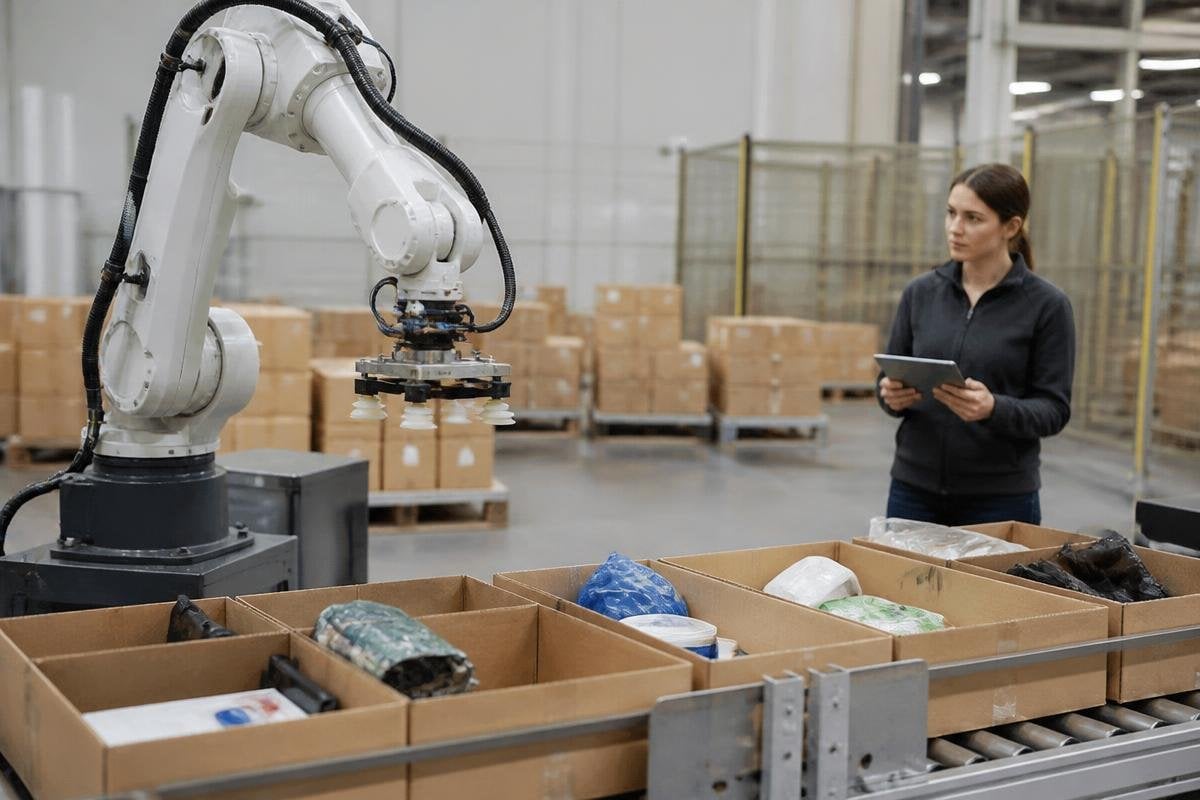
Robots can move with great accuracy in a fixed cell, yet many still struggle when the floor, object, or task changes. The hard work now sits between the demo and the daily shift: sensing, handling, safety, software, and service.
Quick read
- A robot can repeat a known motion while failing on a new object.
- Factory integration often takes more work than buying the arm.
- Power, safety checks, and maintenance limit useful operating time.
Robots still struggle with changing objects
Most factory robots work best when the parts arrive in the same position every time. A vision system can find an object, but finding it is only the first step; the gripper must also hold it without slipping, crushing, or dropping it.
That problem grows with soft bags, shiny parts, tangled cables, and items packed close together. The arm may have six degrees of freedom, meaning it can move and turn in six separate ways, yet it still needs a reliable grip and a clear path to the object.
Mobile robots face a related problem. LiDAR measures distance with laser pulses, while cameras record visible images, but dust, reflective surfaces, poor light, and people moving through the route can still confuse the system. When the robot stops often, it may be safe, but it won’t move enough goods to justify its place on the floor.
Integration takes more than a robot
A machine rarely works alone. It may need to connect with a conveyor, a warehouse system, a safety scanner, a charging station, and a human operator’s work process. Each connection adds a point where timing, data, or physical layout can cause trouble.
ROS 2 gives robot software a common way to pass messages between parts of a system. It doesn’t remove the work of setting up sensors, checking network behavior, writing task logic, or proving that the complete cell behaves safely.
This is why a robot can look ready in a controlled demonstration and still need months of site work. The arm may be proven, while the handoff to the conveyor or the software that sends the next job remains unfinished.
An unfinished handoff can keep a proven arm out of daily work. Reports at Robot24.com can place the task beside its test setting and the human role around it, so you can see which bottleneck remains before the machine meets the safety rules of a working site.
Safety slows useful motion for good reason
A robot sharing space with people needs more than accurate movement. The full system must detect people, stop or slow safely, recover from faults, and make its state clear to the operator.
Industrial robot cells commonly use ISO 10218, a safety standard for industrial robots and robot systems. Meeting a standard does not make a cell safe by itself. The installer still has to check the layout, stopping distance, tools, software, and work steps at the actual site.
Safety can reduce speed or limit where the robot may move. That trade matters in warehouses and factories, where a small number of stops repeated across a shift can remove much of the expected output.
Power and service limit the workday
Frequent charging or careful repair can keep a robot from running a process for long. Battery size adds weight, while higher speed and heavier payload use more power. Designers have to choose where the machine spends its energy.
Service brings another limit. Motors, gearboxes, grippers, cameras, cables, and batteries can fail at different rates. A site needs spare parts, fault logs, trained staff, and a safe way to put the robot back into service.
The software side also needs care. A sensor change can affect calibration.
A new object can require a new grip point. A small layout change can alter the robot’s route or stopping area.
A practical buying checklist
Before you approve a robot project, check these points:
- Name the task: write the object sizes, weights, locations, and expected cycle time.
- Test the bad cases: include poor lighting, damaged packaging, blocked paths, and dropped items.
- Map the handoffs: list every conveyor, database, scanner, charger, and operator step.
- Set a safety plan: identify stop zones, recovery steps, guarding, and inspection duties.
- Price the service: include spare parts, software work, training, and planned downtime.
- Set a proof gate: require measured output during normal work, not only a prepared demo.
I’d put integration and service ahead of peak speed when comparing systems. A slower robot that keeps working through a full shift can produce more useful output than a faster unit that needs frequent stops.
The robotics boom will move at the pace of these practical fixes. The next useful proof is a robot that handles changing work for weeks, with measured output and clear service records.
